Sunday, May 31, 2020

Reverend Thomas Hooker

Dear Grandfather Hooker,

Today, May 31st we are marking the anniversary of your delivery of your most well remembered sermon at Hartford, Connecticut in 1638. Those of us who are students of the origins of the United States of America, consider it to be among those sentiments that led to our Declaration of Independence. Your declaration that "the foundation of authority is laid firstly in the free consent of the people" was passed on by Henry Wolcott, Jr. who was in attendance at church that day and made handwritten notes of your revolutionary statement.

In the 21st century, most have forgotten that in your time, the world was dominated by Kings and Emperors and that normal, everyday people had little, if any say, in their government. Your sermon is credited with providing some of the impetus for Connecticut citizens to ratify, in January 1639, the Fundamental Orders of Connecticut, the first known written constitution to form a basis of government. According to the Office of the State Historian (Connecticut) historian John Fiske wrote 150 years later that the Fundamental Orders "mark the beginnings of American Decomcracy, of which Thomas Hooker deserves more than any other man to be called the father."

So who were you? Some records are lost to history. You were born in Leicestershire, either at Marfield or Birstall on July 5, 1586.

You recieved your first formal education at Dixie Grammar School, a free school in Market Bosworth. Following that you matriculated at Queen's College, Cambridge University in 1608 and then transferred to Emanuel College where you received your BA in 1608 and your MA in 1611. You later studied Divinity there.

Front Court Emanuel College, Cambridge
Photo by DAVID ILIFF. License: CC BY-SA 3.0
In 1620, you were preaching at St. George's Church, Esher, Surrey and it was there you earned your reputation as an excellent speaker and were noted for good pastoral care of your parishners.

St. George's Church, Esher where Rev. Thomas Hooker preached circa 1620.
Church was not remodeled during the Victorian era and appears much as it was in Hooker's day.
from Wikimedia Commons
Perhaps it was the reputation you gained in Esher, that led to you being hired as a lecturer and preacher for St. Mary's Church in Chelmsford under John Michaelson. Archbishop William Laud decided to suppress church lecturers in 1629, and you left to run a school at Little Baddow, just to the east of Chelmsford. We don't know exactly when they were able to identify you as a leader for the Puritan sympathizers but we do know that your were summoned to the Court of High Commission and later forfeited your bond and fled to Rotterdam, The Netherlands. These difficulties led you to seek a new start in Massachusetts. Some reports say that your congregation from Chelmsford preceded your journey to Massachusetts and wrote to you in Holland inviting you to come and once again serve as their leader.

The Governor of Massachusett, John Winthrop, recorded the arrival of Griffin in his diary writing,
 “The Griffin, a ship of three hundred tons, arrived (having been eight weeks from the Downs). This ship was brought in by John Gallop a new way by Lovell’s island, at low water, now called “Griffin’s Gap”. She brought about two hundred passengers, having lost some four, whereof one drowned two days before, as he was casting forth a line to take mackerel. In this ship came Mr. Cotton, Mr. Hooker and Mr. Stone, ministers, and Mr. Pierce, Mr. Haynes (a gentleman of great estate), Mr. Hoffe, and many other men of good estates. They got out of England with much difficulty, all places being belaid to have taken Mr. Cotton and Mr. Hooker, who had been long sought for to have been brought into the high commission; but the master being bound to touch at the Wight, the pursuivants attended there, and, in the meantime, the said ministers were take in at the Downs. Mr. Hooker and Mr. Stone went presently to Newtown, where they were to be entertained, and Mr. Cotton stayed at Boston." 
Hosmer, James Kendall ed. (1908). Winthrop's Journal, "History of New England," 1630-1649. Charles Scribner’s Sons, New York. https://archive.org/details/winthropsjourna05hosmgoog

Drawing of Griffin from GENI
Among the passengers were your wife Susanna and children John, Samuel, Sarah, Joanna and Mary.
(For family members, another of my 11th great grandfathers, John Gallop, was also aboard Griffin.

It must have been wonderful for you and your family to be reunited with your friends from Chelmsford who had settled in Cambridge, Massachusetts. Once you were pastor of your old congreation, you are quoted as saying, "Now I live, if ye stand fast in the Lord."

Plaque honroing Thomas Hooker's Ministry at First Church of Cambridge, Cambridge, MA
https://en.wikipedia.org/wiki/Thomas_Hooker
I suppose for non-comformists such as yourself and your congregation, the appeal of new land in Connecticut where you could worship exactly as you choose was overwhelming. In 1636, all of you removed to the banks of the Connecticut River where you were among the founders of Hartford.

from Wkimedia.org
Today, we are largely kept at home by a viral pandemic. Our understanding is that your death on July 7, 1647 was caused by a prevalent epidemic. Some times have not changed. Your death was considered a great public loss. Gov. Withrop wrote, "That which made the stroke more sensible and grievous, both to them and to all the country, was the death of that faithful servant of the Lord, Mr. Thomas Hooker, pastor of the church of Hartford; who for piety, prudence, wisdom, zeal, learning, and what else might make him serviceable in the place and time he lived in, might be compared with men of the greatest note." (Appletons' Cyclopedia of American Biography, 1600-1889, Vol III, p 251) That is high praise indeed. It is believed that you are buried in Hartford's Ancient Burying Ground and there is a plaque to your memory on the wall in the current building of the chuch you founded. You are not forgotten.

Hartford, Connecticut from www.wikipedica.org

Love,
Your 11th great granddaughter
Cecily

For family members, here is our descent from Thomas Hooker

Rev. Thomas Hooker married Susanna Garbrand
Mary Hooker married Rev.  Roger Newton
Capt. Samuel Newton married Martha Fenn
Susanna Newton married Joseph Plumb
Susanna Plumb married Nathan Nettleton
Anne Nettleton married Samuel Woodruff
Andrew Woodruff married Miranda Orton
Olive Woodruff married Stephen Sanford
Caroline Beckworth Stanford married Reuben Newton
Charles Shepard Newton married Mary Elizabeth Clarke
Helen Brown Newton married Frederick Naaman Cone
Charles Newton Cone married Hazel Bynum Allen, my paternal grandparents.

The two Newton lines do not seem to be related. Though both English, Rev. Roger Newton's line is from Lincolnshire and Reuben Newton's line goes back to Bures St. Mary, Suffolk.

Monday, May 25, 2020

On Memorial Day We Always Remember

Dear Grandparents,
This was first published a few  years ago but it seems proper to repost it on Memorial Day 2022.
Our family has a strong tradition of men and women who have served our country from the Revolutionary War to present day. By and large, they have survived their service to go on to have careers, families, and long lives. Today, as we commemorate another Memorial Day, I want to write about two family members who were not so lucky and made the ultimate sacrifice for our country.

My 2nd great uncle, Theodore William Clarke, served with the First Nebraska Infantry fighting for the Union during the Civil War. He was an unlikely soldier and most of what we know about him comes from the more than forty letters he wrote home to his mother Lydia Hornell Clarke and sister Mary Elizabeth Clarke Newton. The letters have been carefully preserved and handed down through the generations.

Theodore or "Trit" as he was nicknamed by the family was an unlikely soldier. Born about 1838 in Michigan, he was working for the telegraph company laying wire across Missouri and the Nebraska Territory when the war broke out. On July 15, 1860 he writes home stating, "I am in the employ of the Western Union Telegraph Company. We are engaged in the construction of the Pacific Telegraph running from Saint Louis to San Francisco in California... We're going along the Missouri River as far as Omaha City and then across to Fort Kearney... which is as far as we shall get before cold weather sets in." He is anxious for his little sister Molly, my 2nd great grandmother, to understand where he is and write August 5, 1860 from near Nebraska City, "It is about 60 miles from here to Omaha City and 180 from there to Ft. Kearney. By allowing about 5 miles for every working day you can look on your map and see anytime where I am."

Theodore William Clarke
from tintype in my possession

Though he is busy with work he is not undecided about who should win the Presidential Elections of 1860. Writing September 21, 1860 he states, "Why Lincoln's the man of course and if the territories and Kansas and Nebraska had a voice in the coming election Douglas would hear a noise that would make him stuff his ears with cotton and send him to visit with his mother for the next four years at least."

Trit stays with Western Union until they complete the line to Ft. Kearney and he learns to become a proficient telegraph operator feeling that he is making good money doing so. However, the situation changes when word of the secession of the southern states reaches the Nebraska Territory. He enlists as a 'fifer' or musician with the First Nebraska Infantry explaining to his mother on July 16, 1861, "I can never have it said that I, who have no one dependent on me and nothing but my life to loose, stood back in this hour of our country's peril and remained an inactive spectator."

His words turned out to be prophetic. Theodore spent more than 18 months with the First Nebraska, surviving the Battles of Ft. Donelson, and Shiloh before dying January 7, 1863 in Van Buren, Missouri. Like the majority of the Union casualties, Theodore died not of wounds but of a disease probably  something like pneumonia.
Battle of Fort Donelson fought February 14 through 16, 1862.
Picture created by Kurz & Allison 1887
www.lincolncollection.org

I wish I could report that family members can visit Theodore's tombstone and place flowers their each memorial day in remembrance of his sacrifice. Unfortunately, his final resting place is unknown. When ever I visit Arlington National Cemetery, I like to imagine that our Trit is one of the 'unknowns' honored there.

My cousin Phelps Wilson Long, Jr. also gave his life, not in a national catastrophe but in a global conflagration. The 1940 Federal Census finds Phelps as a 16 year old, living with his family and attending high school.
His father Phelps and mother Martha Allen Long were running the family department store in Tallahassee, Florida. Little sister Shirley was in the sixth grade. An older cousin Lindsay Pappy also lived in the home.

1940 U. S. census, Leon County, Tallahassee, Ward 2, Florida, population schedule,
Page 2, penned, lines 31-36, house number 1016, Thomasville Rd., digital images
Ancestry.com (http://www.ancestry.com: accessed 24 May 2014);
citing National Archives microfilm roll: T627_597; Page: 8A; Enumeration District: 38:3.
After High School, Phelps went off to the University of Florida in Gainesville and joined Sigma Alpha Epsilon Fraternity. Probably no one anticipated the changes that would effect the family and nation in the next couple of years.

Phelps is fourth from the right in the bottom row of the  University of Florida
Seminole Yearbook image from www.ancestry.com

The first year following the Japanese attack on Pearl Harbor did not go well for American forces. Many young men like Phelps felt an urgency to do their part for the war effort. Phelps enlisted in the United States Marine Corps and was sent to New River, North Carolina for training.
Private Phelps W. Long, Jr.
copy of photograph in possession of his sister. Used with permission.

Phelps' unit was eventually sent to the South Pacific to take part in the battle for Bougainville, a strategic island that had been held by the Japanese since 1942. His unit, the 3rd Marine Division was given the task to take the hilly area around the Japanese field artillery. One of the most difficult positions to take was an area called "Helzappoppin Ridge". The Marines attacked there on December 12th. It wasn't until the 18th that coordinated attacks allowed the American troops to capture and control the ridge. Phelps was killed on the 16th.

His death left a huge hole in his tight knit family. My grandmother Hazel Allen Cone (his mother's sister) said that his mother never recovered from his loss. She died a mere five years later at age 47. Talking with his sister Shirley Long Collins last month is Tallahassee, she said that her father never got over Phelps death either. I could see the sadness over of the loss of her brother that remains with Shirley to this day. Phelps' parents eventually paid to have their son's remains returned to Florida for burial.

Hopefully, we will all take time among the picnics, boat rides, cookouts and other festivities to remember those whose sacrifices have secured our country and way of life.

Love,
Cecily Cone Kelly

P. S. For family members - Phelps W. Long was my paternal grandmother's nephew and my father's first cousin. Theodore Clarke is also on my paternal side, the brother of my 2nd great grandmother.

P.P.S Since this was written, I've discovered that Phelps Long received a posthumous Silver Star for his attempted rescue of another wounded Marine. His citation reads, "For conspicous gallantry and intrepidity while serving with the Third Marine Division in action against enemy Japanese forces in the Cape Torokina area Bougainville Island, Solomon Islands on December 16, 1943. He "courageously volunteered with another man to carry a stretcher out to a dangerous position in front of his lines and bring back a wounded pharmacist's mate. PFC Long made his hazardous way forward in the face of hostile fire and under extremly difficult conditions, succeeded in placing the injured man on the stretcher. Subsequently, raising himself slightly to move to the rear of the stretcher and pick it up, he was mortally wounded by Japanese sniper fire." The newspaper article also mentions that his parents also "received a letter from their son's company commander, Capt. Robert R. Lamb, USMC expressing tribute to the young Marines gallant bravery."

Thursday, May 7, 2020

Kees' father Jan Schipper's birthday.

Dear Kees,
I have a genealogical calendar that shows family events that have occured through the years on this date. Today it mentioned that it was the anniversary of your father, Jan Schipper's birthday, 7 May 1900. He was born in Texel, Noord Holland, The Netherlands. He was the first child of his parents Gerri and Marijtje (Platvoet) Schipper. Seven other children followed.
Birth Registration for Jan Schipper
https://www.wiewaswie.nl/nl/detail/55491995
Texel (pronounced Tessel) is an island off the coast of the Netherlands know for its dumes and bird life. It is well known for the Dunes of Texel National park filled with beaches, grass topped dunes and trails through the forest. It must have been a beautiful, if sparsely populated place to live.
Map of Texel just off the coast at Den Helder
One of the buildings that your father knew still exists, the Texel Lighthouse at the end of the dunes.
19th Century Texel Lighthouse VVV
You can't imagine how we are living these days with most of us under stay at home orders. Because many are having difficulty adjusting to these times, there have been several posts about what challenging lives those who were born in the early 20th century lived. They were young teenagers when World War I began. Considering the times most would have left school and begun their trades. Though Netherlands maintained its neutrality during the war, the population was not un affected. The Royal Netherlands Army was mobilized throughout the war and the Dutch provided housing for refugees, captured soldiers. The government also restricted the free movement of the Dutch people.

Of course, the War was followed by the depression and then the Second World War. Your father lived through very difficult times. I remember you telling be that you thought the deprivations he experienced during World War II had just worn out his body. He died, much too young, on 25 Jun 1951.

Today we salute his memory!
Love,
Cecily

Thursday, April 16, 2020

Our Ancestors Knew Each Other

Dear Grandparents,
This will come as no surprise to you but we do not often think that our friends and relations may have known each other. One of my volunteer positions is as Registrar for my National Society Daughters of the American Revolution Chapter. I'm sure my grandmother, Grace Colby Werst Branchflower, has been very pleased that I've proved our ancestry to her Patriot Evert Van Epps (and I have supplemental applications pending on many of the rest of you). As Registrar, I help others research their ancestors and submit their applications.

This week I've been helping one of our new members, Kay Pontious, delve further into her Patriot Jonathan Taylor's role in the American Revolution. He's one of the Patriots who applied for and received a pension and after his death his widow was also granted a pension. His is an interesting case. He enlisted in the 3rd Regiment of Light Dragoons, Virginia Line in Cumberland, Virginia.
He fought in New Jersey. He settled in the Edgefield District in South Carolina and then his widow and family moved on to Walton County, Georgia.

Now Jonathan Taylor's story is not really mine to tell but in reading the pages of his and his wife's pensions over the phone to Kay, I came across a name that is in our family tree. Robert Milner Echol's is my son-in-law Chris' 4th great grandfather.

Robert Milner Echols
18 Mar 1798 - 3 Dec 1847
Photo from https://www.findagrave.com/memorial/7190349/robert-milner-echols add by Terry Echols.
Robert Milner Echols was born in Wilkes County, Georgia but soon settled in Walton, County not far from Monroe. He served in the Georgia General Assembly and also the Georgia Senate where he was three times elected president of that body. He also served as a judge in Walton County. It is in his capacity as judge that I found his name in Jonathan Taylor's pension.

Document from the Pension file for Jonathan Taylor of Virginia
https://www.fold3.com/image/18461544
The best thing about finding this signature is that on a following page in the document, Jesse Mitchell, Clerk of the Inferior Court, attests to the signatures. So, we know that Chris' family and Kay's family had contact with each other. Small world isn't it.

Love,
Ceciy

For family members: The descent from Robert Milner Echols
Robert Milner Echols married Mary "Polly" Melton (her brother Eliel Melton died at the Alamo)
Mary Ann Tabitha Echols married James Troup Scott
France Ella "Fannie" Scott married George Washington Outlaw
Bertha Outlaw married George William Cunningham
Geraldine Louise Cunningham married Charlie Campbell Black - Chris' Grandparents
Which makes makes Robert Echols my grandchildrens' fifth great-grtandfather.

Wednesday, April 1, 2020

Joseph Platt's Baptism Day

Dear Grandfather Joseph,
Usually people identify most with the ethnicity of their birth surname. Mine is Cone, which was shortened according to family legend from MacCough, and is clearly of Scottish origin. If the truth be told, I have many more English than Scottish ancestors. I use a genealogy software program called Legacy Family Tree. It has a wonderful report format that reports births, marriages, and deaths from my family tree by date. There are no fewer than 25 people in my tree that have significant events on April 1st. I decided to write about you today because, quite frankly, your surname is one that I had forgotten was in my family tree.

Though April 1st may also be your birthday, documentation shows it to be the day of your baptism in Milford, Connecticut. Your parents are Richard and Mary (Wood) Platt. Richard was baptized in Ware, Hertford, England May 6, 1604. He married at Roydon, Essex, England Mary Wood, daughter of John and Jane Wood, January 26, 1628/9.
St. Peter's Church Roydon - the only building in Roydon that dates from before their marriage.
Photo By Robert Edwards, CC BY-SA 2.0, https://commons.wikimedia.org/w/index.php?curid=9296086
Ware, a market town, is about 5 miles from Roydon. It was known as a hotbed for Puritanism. Rev. Charles Chauncey, who went on to become the President of Harvard, was vicar from 1627 to 1633.
He immigrated to New England about 1638 and Richard and Mary followed not long after as he was admitted to the church at New Haven January 29, 1639 (Connecticut Vital Records [The Barbour Collection]1630-1870, vol. Milford p. 128.). Richard was one of the original Proprietors of Milford, Connecticut. In 1643, he received an allotment of 4-1/2 houselot, 27-1/2 upland and 13 meadow acres. He held the houselot, 6-3/4 in East Field, another 20-3/4 in East Field, 4-1/2 in The Meadow and 1 acre in Harbour Meadow.

Milford must have been an interesting place. For all the strictness for which the Puritans were known, evidently there was still time for mischief. According to court records, you were part of a 'silly prank' when you and several friends snuck out in the dead of night and destroyed a Wepawaug Indian fort which was unoccupied at the time. Your motives were not disclosed and it is unclear if the group was fined 10 pounds or if each member was fined 10 pounds. You also had to rebuild the fort.

You had settled down by the time you married Mary Kellogg on May 5, 1680 and went on to a steady career which included being Lieutenant of the Train Band (militia) in 1698 and Deputy from Milford to the Connecticut General Assembly in May 1700.
One of the oldest building in Milford dates from circa 1700 and would have been recognized by Joseph.
By Sgt. R.K. Blue - Own work, CC BY 3.0, https://commons.wikimedia.org/w/index.php?curid=14582442
There is some question about your death date but an inventory was taken of your estate March 21, 1703/4. Of your children, only my ancestor Mary was of age.

I'm glad your baptism date popped up on my calendar today. It's always fun to know that not all my Puritan ancestors were staid, sticks-in-the-mud.

Love,
Cecily

For Family members: our descent from Joseph is as follows
Joseph Platt and wife Mary Kellogg
John Woodruff and wife Mary Platt
John Woodruff and wife Hannah Andrew
Samuel Woodruff and wife Anne Nettleton
Andrew Woodruff and wife Mirand Orton
Stephen Sanford and wife Olive Woodruff
Reuben Newton and Caroline Beckworth Sanford
Charles Shepard Newton and wife Mary Elizabeth Clarke
Frederick Naaman Cone and wife Helen Brown Newton
Charles Newton Cone and wife Hazel Bynon Allen
Charles Newton Cone,Jr. and wife Betty Lorraine Cone - my parents.


Tuesday, March 31, 2020

Happy Anniversary John and Sarah (Noyes) Hale

Dear John and Sarah,
Today we are remembering the 336th anniversary of your marriage in Beverly, Massachusetts. It was sort of a May-December marriage, you, the groom, 47, and your bride 29. 

Both the Hale and Noyes families were of English origin. The exact origin of the Hales remains unknown. Sarah's father, Rev. James Noyes, was born about 1608 in Cholderton, Wilts, England, the son of Rev. William and Anne (Parker) Noyes. William matriculated at University College, Oxford in November 1588 and received his BA Degree May 21, 1592. He became the Rector of Saint Nicholas Church in Cholderton in 1602.

Drawing of the first St. Nicholas Church, Wilts, England. Church is
supposed to have been constructed by the Saxons. The following is from the Church Records,
"The Church of St. Nicholas, Cholderton, was given to the Monks of St. Neats about 1175 and
the grant was confirmed by Pope Alexander III."
used with permission from http://evermore.imagedjinn.com/blg/154/data-concerning-the-church-of-st-nicholas-at-cholderton-wiltshire-england/
William's and Anne's sons, James and Nicholas, along with Sarah (Brown) Noyes and cousin Thomas Parker swore oaths of allegiance so they could sail for New England on the Mary and John under Master Robert Sayres arriving at Boston in March 1634.

James and Sarah settled in Newberry where they had ten children, Sarah being the youngest. Unfortunately, James died when Sarah was only a year old.

Photo from Find A Grave Memorial ID 35286148 added by
Paul M. Noyes, used with permission
Headstone is located at the First Parish Burying Ground,
Newbury, Massachusetts
John Hale's father Deacon Robert Hale is one of the immigrants covered in Robert Charles Anderson's "The Great Migration."  The ship he arrived on is unknown but we know that he was in Boston by the fall of 1630 when he was admitted to the Boston church as member #18. His occupation was carpenter. One source, U. S., New England Marriages Prior to 1700, gives his wife's name as Joanna Cutter and a marriage date of October 14, 1632. By that date Robert and Joanna removed to the church at Charlestown. John, born June 3, 1636, was the oldest of their five children.

John was educated at Havard and graduated in 1657. After graduation, he moved to Beverly where he had been hired to teach religion. On September 20, 1667 he was ordained pastor of the newly organized church at Beverly. He remained in this post until his death.

As an upcoming young man, John married Rebecka Byles December 15, 1664 in Ipswich. They had four children, John, James, Rebecca and Robert before she died April 30, 1683.

Rebekah Byles Hale Headstone
Find A Grave Memorial ID 48178556 photo by Jude
Abbott Street Burial Ground, Beverly, Massachusetts
After a marriage of nearly 20 years, John missed being wed. Both the Noyes and Hale families were Puritans. Beverly and Newbury were only about 20 miles apart so it is assumed that the families were acquainted. At 29 years of age, Sarah was either very picky or had not been interested in any propsed suiters. We don't know why John appealed to her or if the courtship was long. We do know that you were married this day in 1684.

Two sons were born of this marriage, James in 1685 who also became a minister and Samuel who was born in 1687 (Nathan Hale, martyr of the American Revolution, is Samuel's grandson but that is a story for another day).

Kitchen at Hale House photo by author March 2017
There are many more tales to tell of your marriage but those also will be saved for another day. My siblings and I visted your home in Beverly which stands to this day and is a museum maintained by the Beverly Historic Society.

So Happy Anniversary. You have not been forgotten by your descendants.

Love, Cecily

P.S. for family members our descent is as follows:
John Hale and wife Sarah Noyes
James Hale and wife Sarah Hathaway
James Hale, Jr. and wife Elizabeth Bicknell
Eleazer Warner and wife Joanna Hale
Thomas Warner and wife Rhoda Hopkins
Naaman Cone and wife Joanna Warner
William Warner Cone and wife Eliza Utley
Frederick Naaman Cone and wife Helen Brown Newton
Charles Newton Cone and wife Hazel Bynon Allen
Charles Newton Cone, Jr and wife Betty Lorraine Werst

Sunday, March 1, 2020

Happy 355th Birthday Grandfather Samuel Huntington,
Can you imagine, a descendant, 11 generations removed from you, knowing that today is your birthday? I feel certain that your would be shocked by the amount of information we know about you so many years later.

I've just returned from Salt Lake City, Utah and RootsTech 2020, a convention gathering of thousands of Genealogy and Family History enthusiasts and professionals from around the world. In noticing on my Legacy Family Tree Software calendar report that today was your birthday, I thought about all of the services represented at RootsTech that I have used to discover more about your life story.

The Huntington Family began meeting to discuss their family history in Norwich September 3, 1857.  That lead to the publication of The Huntingon family in America: a genealogical memoir of the known descendants of Simon Huntington from 1633 to 1915, including those who have retained the family name, and many bearing other surnames published in 1915. This book is available online from a variety of sources.

Their research states that you were born in Norwich on March 1, 1665 in Norwich, Connecticut the son of Deacon Simon and Sarah (Clark) Huntington. Deacon Simon was born in Norwich, England May 6th 1629. He came to New England with his parents Simon and Margaret (Baret or Barrett) Huntington in 1633. The elder Simon died of smallpox enroute and was either buried at sea or at the mouth of the Connecticut River.

I use Ancestry.com to research and build family trees. They have collected billions of records including a database that they've built entitled US, New England Marriages Prior to 1700 the orginal source comes from Clarence A. Torry's "New England Marriages Prior to 1700" published in Baltimore by the Genealogical Publishing Co. in 2004.


You could help us with one problem. Many genealogists think that Mary's father is the John Clark who married Sarah Treat. Others believe Mary to have been the daughter of William Clark of Wethersfield.

Our records show that you and Mary are the parents of eight children: Elizabeth who married Moses Clark. Samuel who married Hannah Metcalf, Caleb who married Lydia Griswold, Mary who died young, Rebecca who married Joseph Clark, Sarah about whom we only know her birthday, John who married Mehitable Metcalf, sister of his brother Samuel's wife,  and Simon who married a Sarah, surname unknown.

You served as a military officer and were entered in the rolls in Norwich as Lieutenant. Your service impressed the people of Norwich and you were granted a parcel of land at Trading Cove Brook, "by the fathers to be laid out by measure, 30 or 40 rods wide, the length of his father's land."
I wonder if you would recognize your land on this map from July 1892.

Norwich, Connecticut Sanborn Insurance Map 1892
Library of Congress
You relocated to Lebanon in 1700.  In 1710, the citizens of Lebanon appointed you to a commission trying to resolve a dispute over the location of a new meeting house. As far as we know, you lived the rest of your life in Lebanon.


Headstone for Lt. Samuel Huntington from the Old Cemetery
at Lebanon, New London County, CT from Find A Grave Mem. #46073474
photo by Brett, used with permission
As you can see, it is difficult if not impossible to decifer the words chiseled on the stone. Not to worry. I discovered the inscription on your headstone at American Ancestors, the on line site for the New England Historical Genealogical Society. Since 1845, this organization has built a comprehensive resource library for family history research and has become the largest Society of its kind in the world.

"Here Lyes ye Body of Leiut Samuel Huntington, Geneleman, Who Died May ye 19, 1717 & In ye 52nd Year of His Age."
from Connecticut, Wills and Probate Records, 1609-1999
this collection is from the Connecticut State Library
and can also be found on www.Ancestry.com 
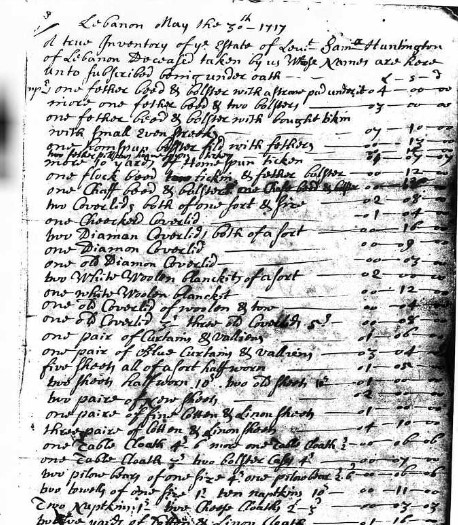
We've also found your Probate Packet containing 1 bond, 2 inventories, 2 distributions, 1 account of Administration, 18 receipts and 1 miscellaneous item. Theses were deposited in the Connecticut State Library under provisions of the Public Act 1909 Chapter 175 and were added July 23, 1912. I've included a photograph of the first page of your inventory. I wonder if you would feel accomplished or embarassed by the number of items listed. What would you think of the valuation of your items?

Love your 9th great granddaughter,
Cecily

My descent from Lt. Samuel follows:
his daughter Elizabeth Huntington married Moses Clark
their son James Clark married Ann Gray
their son James Clark married Anna Lyman Tiffany
their son James Clark married 2nd Parnel Champion
their son John Champion Clark married Lydia Hornell
their daughter Mary Elizabeth Clark married Charels Shepard Newton
their daughter Helen Brown Newton married Frederick Naaman Cone
their son Charles Newton Cone married Hazel Bynon Allen
their son Charles Newton Cone, Jr. married Betty Lorraine Werst
they are my parents and there are two more generations