Sunday, February 23, 2014

New York Ancestors

Dear Grandparents,
My sister will be visiting the finger lakes region of New York for a family wedding this summer and asked about the areas where you lived. I'm not certain she realized that each of our eight great grandparents had family members who lived in New York. Today I'm beginning a series of posts that highlight our New York connections.

The red highlighted area on the New York state map is Steuben County. Named for Baron Frederic William Augustus Von Steuben, the German drill master who helped George Washington turn his volunteers into an effective fighting force, Steuben county was created March 18, 1796. It covers an area larger than the state of Rhode Island and remains rural with a population of about 100,000.

Hornellsville is located in middle of the western part of the county.

Our Steuben County connections include:

Uriah Stephens (6th great grandfather) born 27 August 1730 in Canaan, Litchfield, Connecticut emigrated to Canisteo with his family in 1788 including his wife Martha Rathbone or Rathbun. Their daughter Martha Stephens married George Hornell.
Martha Rathbun Stephens tombstone from the Old Settlers' Cemetery, Canisteo, NY.
Used with permission and thanks to cousin and also 6th generation descendant Gary Goodridge.
www.findagrave.com

Judge George Hornell (5th great grandfather), a native of York, Pennsylvania, settled in the area in 1793. He bought 3,000 acres and built saw and grist mills. The town was named for him after his death.
George Hornell's trunk in the Hornel Library 2012

George Hornell, Jr. (4th great grandfather) born 08 Aug 1792 was raised in Hornellsville. He became a lawyer and then a Presbyterian minister. He sold the family holdings in Hornell and became a missionary to the Indians in Michigan. He married Sarah Thacher.
George Hornell, Jr.
Nathaniel Thacher (5th great grandfather) was living in Canisteo, Steuben County at the time of the 1810 census. His wife,  Lydia Place, died in Hornell 23 September 1853. She is buried in the Hope Cemetery in Hornell. (Still would like to know why great grandfather Nathaniel died 23 August 1824 in Florence, Lauderdale, Alabama.)
Tombstone of Lydia Place Thacher
Naaman Cone (3rd great grandfather) was born 11 September 1804 in Laurens, Otsego County, New York. He moved to Hornellsville sometime after 5 October 1850 when he was listed as living in New Lisbon, Otsego County in the 1850 Federal Census. He is shown 06 June 1855 in the New York State Census with wife Joanna (nee Warner) sons Ira, Elijah, Eleazer and daughter Mary.

William Warner Cone (2nd great grandfather) born 18 October 1827 in New Lisbon, Otsego County, he married Eliza Utley 30 November 1854. They were residing in Hornellsville, when my great grandfather
Frederick Naaman Cone was born 29 March 1859.
William Warner Cone

Love,
Cecily Cone Kelly

Sunday, February 16, 2014

Fort Donelson Captured from Confederates 152 years ago today.

16 February 2014

Dear Uncle Trit,
Today we mark the 152nd anniversary of the Union victory at Fort Donelson. There were more difficult battles to come, so many of today's Americans are unaware that Ft. Donelson was the 10th bloodiest battle of the Civil War.
Our family knows about your participation in the battle while with the First Nebraska Infantry because of the letters you wrote to your mother Lydia Hornell Clarke and sister Mary Elizabeth Clarke Newton, my 3rd and 2nd great grandmothers. Your letters have been lovingly preserved and passed from generation to generation.

First page of letter addressed "Dear Sister & and Mother"
Ft. Henry Tenn, Feb 23rd 62
This letter begins;
Dear Sister and Mother,
"You doubtless have heard before this of our great and glorious victory at Ft. Donaldson [sic] but I suppose you didn't know I was there as the newspaper correspondents don't mention names. I can of course give but a meager account of the affair in general but as far as concerns myself I will tell as far as possible."

Map of the Movement from the Battle of Fort Henry to the Battle of Ft. Donelson
from http://en.wikipedia.org/wiki/File:Fort_Henry_to_Fort_Donelson.png
I hope you don't mind my including a map to help you tell the story of the Battle. Ft. Donelson remains an out of the way area in Tennessee, somewhat infrequently visited. Back to your story...

"When I wrote last we were about to start from here to go round by the river, while one division of the army went across by land to hold the enemy at bay while the river division would come up with gun boats.
When we got down to Paducah we were joined by other regiments that were waiting on steamers and five gun boats making in all 17 boats and about 16,000 men. We then started up the Ohio for the Cumberland River and arrived at the point of debarkation on the night of the 12th. We landed in the morning and started for the scene of the action. When we got there the rebels were trying to make a break and get out as they were completely surrounded."
     
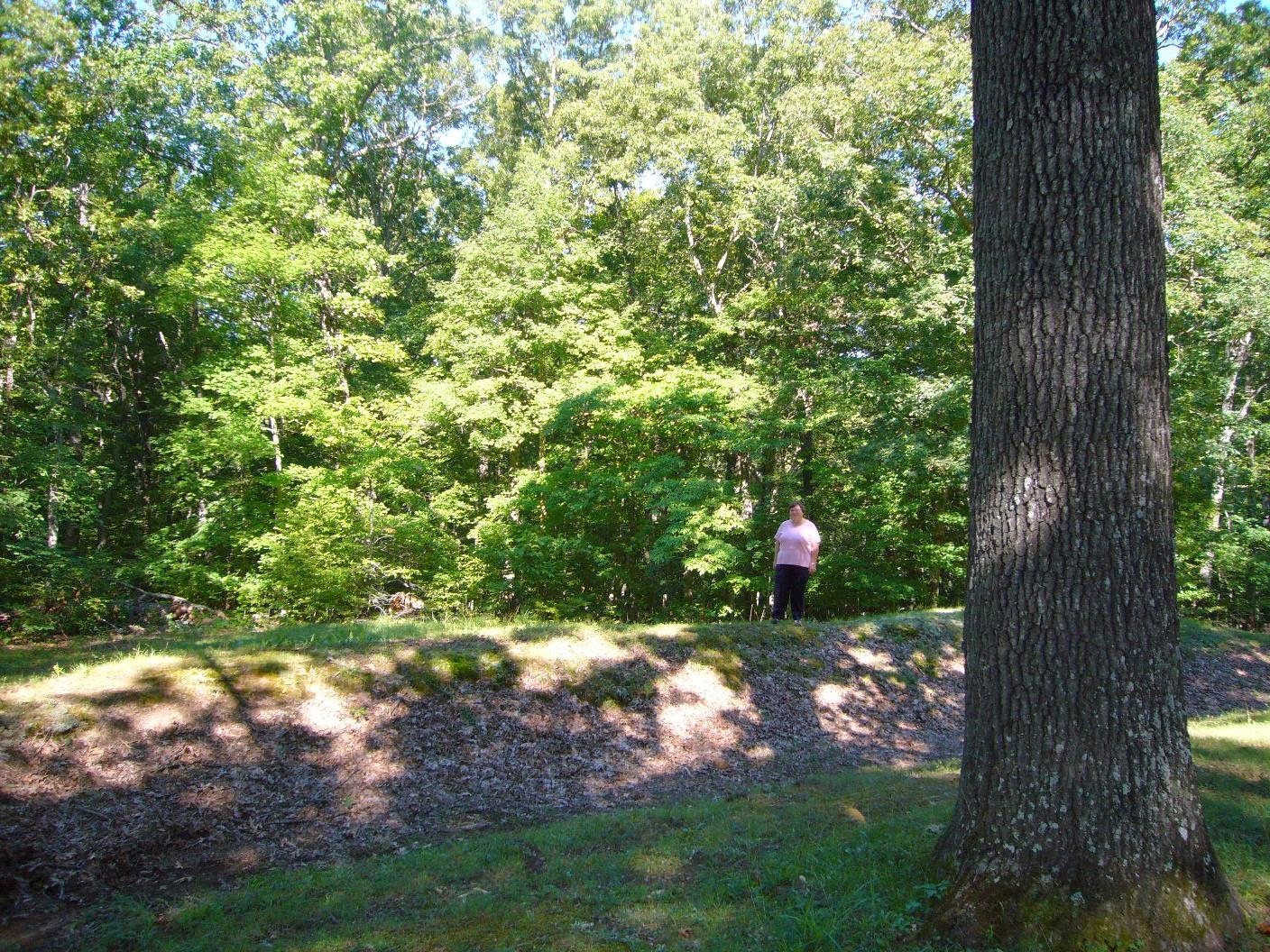
"The country around the Fort is very broken and covered with a dense growth of brush and timber so the place of egress from the place is very narrow with only room for two Regiments to form in line and the different Regiments were guarding the pass by turns supported by batteries of artillery. We lay on the ground all night with only one blanket a piece and about three inches of room between us and the Mother Earth waiting for our time to come."


Area near Ft. Donelson where the First Nebraska
spent the night as it looked in the summer of 2009.
Underbrush is cut back within the park


"At about 10 O'clock in the morning of the 15th the order came for us to fall in and go to relieve some Ind (Indiana) boys who had been fighting all the morning. One Reg(iment) of them, the 31st Ind had been repulsed twice with severe loss. We marched down the road that leads to the Ft. to where there was a Chicago battery posted and then filed to the right down through the thick brush and halted with our left resting on the road and an Ill (Illinois) Reg. in line on our right and an Ohio Reg for reserve in our rear. I had borrowed a gun from one of our sick men and went in with my Co[mpany]." (Note: Theodore "Trit" Clarke had enlisted in the First Nebraska as a fifer, assuring his very religious mother in earlier letters that he did not intend to fire a weapon). "We hardly got into line when here they come at double quick through the bushes."


Battle of Fort Donelson by Kurz and Allison 1887
from the Library of Congress Collection
"We learned afterwards that they came with two of their crack Regiments and 800 picked men from their whole force to make a last desperate effort to capture our battery and break out. Their whole weight came onto our Reg and the Chicago Battery. As they came in sight of the Battery, one of their officer[s] (a Lieut Col) who was riding a horse back at their right pointed to the Battery and said, 'There it is boys, now take it.' Those were his last words for at that instant our left Co opened fire and he fell pierced with eight mini bullets.

The fight now began in earnest as the whole Reg with the Battery opened a most deadly fire on them at about fifty paces distance which they were not slow in returning with interest but we had the advantage of them in position as there was a slight rise in the ground in front of us that we lay down sheltered us from their fire. They stood and took it like men for twenty minutes when finding our fire too hot and no sign of growing weaker they began to fall back and finally broke and ran for their entrenchments in perfect rout leaving their dead and wounded on the ground to the number of about 300. Our loss strange as it may seem runs only two killed and thirteen wounded.

When the enemy had retired, Gen. Wallace who commanded the Brigade rode in front of our Reg and said, "Nebraska will be long remembered for what you have done today. Three cheers for Nebraska! and they were given with a wild, "Our boys did it ably for though the bullets and shells flew around them like hail not a man flinched for a moment but stood up to their work as if they were about their ordinary duties at home.

I suppose you will ask how I felt, well I don't like to brag on my self but I must say I wasn't a bit scared. When we were marching into line I felt a kind of nervous trembling but when the first gun fired I felt as cool as I ever did at home and was very highly complemented by our Major for taking the most deliberate aim of any man that came under his notice.

The boys of the Chicago Battery can not have to[o] much praise for their bravery for they work their guns under the hottest fire with dreadful effect as the right Co of the rebels took only 12 men off the field.

There may be a page of the letter missing here for the next page begins;

...we lay in line all day and the next night waiting for them to try 'it again' but they didn't come. In the morning preparations were made for a general charge on the enemy in their entrenchments but there came the joyful news that they had hoisted the white flag and then arose such a shout as can only come from 30,000 of the bravest men the world has ever produced and we marched in with the bands playing Yankee Doodle and Hail Columbia. We marched to the main Fort and planted the glorious old flag on the battlements while the band played the Star Spangled Banner with thrilling effect. One of the rebels, an old soldier who had fought in the Mexican War said, 'Boys that is the first time I have heard that tune for two years and it is the best tune I've ever heard.'

The rebels were very bitter against Floyd who took his body guard and ran off the night before the surrender which was one cause of their giving up as they did. It was a fine thing for us that they gave up just as they did for if we had stormed the works it would have been at a great loss and of doubtful results as they were very strongly posted. I asked a Mississippi man what they surrendered for as they had plenty [of] provisions and such a strong place. He said,'There is too darned many of you.'

Their officers had told them that we were a set of cowards and would run away if they showed a bold front but they said it was a mistake they found out to their cost. The rebels are a brave lot of men generally but they seem to be very discouraged and homesick. They were sent down the river to Cairo. I think there was about 10,000 or 12,000 taken with all their arms and stores and the strongest fortifications in the west except Columbus.

After the surrender our Reg. marched over to Ft. Henry where we're now quartered in the huts formerly occupied by the Chivalry of the sunny south. I can't tell when our next move will be but I will try and keep you posed as to our movements. I'm afraid I have tired you with my long letter so I will say good bye for this time. Write often and direct as heretofore. I remain your brother and son.

Theodore

PS: I send some Jeff Davis Postage stamps I thought they would be a curiosity. I found them on an old letter in Donelson. Postage must be high for they were both on one letter from Va. I have quite a lot of trophies but they are most to[o] bulky to send in a letter. Do you get the St. Louis paper I subscribed for. I have been getting the Independent regularly. When I read them I turn them over to our chaplain he says they are quite a treasure to him."

Trit
(punctuation and spelling are as in the original letter with a few clarifications)
Theodore William 'Trit' Clarke
Reverse image from tintype in my personal collection.


Your letter tells us what the battle was like for you. It resonates through the ages. I wish we could talk to you now to know if the feelings expressed in your letter remain the same. The Battle of Fort Donelson opened the way to the capture of Nashville, the first confederate state capital to fall to the Union and paved the way for the eventual victory.

Love,
Cecily Cone Kelly

For family members, Trit was the brother of Mary Elizabeth Clarke who married Charles Shepard Newton.

Saturday, February 8, 2014

Playing "Telephone" with Obituaries

Dear Grandparents,

I recently found three obituaries for my 2nd Great-Grandmother Sarah Amanda Gibson Hugunin. They are a good illustration for genealogists on how the facts can change like the messages did in the "telephone" game we played as children.

The obituaries were glued into Amanda's scrap book by her daughter Mamie Hugunin Colby and then passed to her daughter Grace Colby Werst Branchflower and to her daughter Betty Werst Cone and to her daughter Cecily Cone Kelly.


The scrapbook is old and fragile and we have had to remove pages and place them in archival sheet protectors to preserve them.

Among the pages in the book are three obituaries and a set of Resolutions adopted by the Ladies' Aid Society of the Congregational Church in Kirwin. Unfortunately, we do not know from which papers the obituaries come, but it is supposed that they are from the Phillipsburg and Kirwin papers. Last time I visited Phillips County (February 2013) all the bound copies of the newspapers had been sent to the State of Kansas for an eventual on-line access project. I'll have to check again to see if it is finished.


Transcription follows:
From left:
Death of Mrs Hugunin
Died at Phillipsburg, Kansas, March 11, 1894 (someone has crossed out 11 and written 21), of congestion of the brain, Mrs. Sarah Amanda Hugunin, wife of Van E. Hugunin, register of deeds.
Mrs Hugunin was in apparent good health and had started with her husband to attend the social at Dr. Wallace's, when near the Baptist church she complained of being very sick and Mr. H started to take her back home. But she became worse and fell unconscious into her husbands arms. He carried her into Mr. Countryman's and medical aid was immediately summoned but she was already dead before the physician arrived.
Mrs. Hugunin's maiden name was Gibson. she was born in Memphis, Tenn., February 1, 1847, and united in marriage with her now bereaved companion on the 8th day of January 1865 in Edgefield, Tenn. In 1868, they permanently settled in Johnstown, Wisconsin, where they resided until 1877 when they came to Kansas and settled in Phillips county near the town of Kirwin, from which they came to Phillipsburg about two weeks ago, to fulfill the duties of the public office to which Mr. Hugunin had been called,
Mrs. W. W. Colby with a single brother and sister, Walter H. and Grace, are their only children, who share the deep sorrow of their father.
Mrs. Hugunin was an intelligent christian lady and an esteemed member of the Congregational church. Her death, though sudden, and unannounced, was not unprepared for. Her consistent walk as a christian attests her readiness for a change.
The funeral services will take place Saturday, March 25, at 11 a.m. from the Methodist church, Rev. Mr. Strong will be assisted by Rev. Wm. Haresnape, of Kirwin, pastor of the deceased.

Alright, I agree that is a great obituary in terms of what it tells us about the deceased, but look what happens when you read the other obituaries.

Center:
At noon yesterday news reached this city to the effect that Mrs. Hugunin, wife of Van E. Hugunin had died very suddenly in Phillipsburg on Wednesday evening. In company with her husband she was going to church, and died suddenly in his arms, before other held could be summoned. Heart failure was the cause. We are unable to learn further particulars. Miss Lillie Weaver and Mrs. H. Moulton went to that place from here yesterday.

Right:
Obituary
Died - At Phillipsburg, Kan, March 21st, 1894 of congestion of the brain, Mrs. Sarah Amanda Hugunin, wife of Van E. Hugunin register of deeds.
Mrs. Hugunin's maiden name was Gibson. She was born in Memphis, Tenn, February 1, 1847 and united in marriage to her how bereaved companion on the 8th day of January, 1865, in Edgefield, Tenn. In 1868 they permanently settled in Johnstown, Wis., where they resided until 1877, when they came to Kansas and settled in Phillips county near the town of Kirwin, from which place they came to Phillipsburg about March 1st, to fulfill the duties of the public office to which Mr. Hugunin had been called.
Mrs. W. W. Colby with a single brother and sister, Walter H and Grace are their only children, who share the deep sorrow of their father.
Mrs. Hugunin was an intelligent christian lady and an esteemed member of the Congregational church. Her death, though sudden and unannounced was not unprepared for. Her consistent walk as a christian attest her readiness for a change.
Funeral services were held Saturday, March 25th at 11:00 a. m. from the Baptist church, Rev. Mr. Strong assisted by Rev. Wm. Haresnape of Kirwin, pastor of the deceased officiating.

Obviously, the 3rd obituary writer had the benefit of reading from the first even then some of the facts changed. For instance, the funeral is held at the Baptist instead of the Methodist church.

I know, I know,  one should not complain about finding one let alone three obituaries for an ancestor. I simply note the differences in the accounts of Amanda's death at age 49. Also, interesting that the four grand-daughters that were living outside of Kirwin are not mentioned. Finally, what a great surname is Haresnape!

Love,
Cecily

Wednesday, January 8, 2014

Dear Grandmother Lydia,
I want to update you on my search for additional information on Theodore William "Trit" Clarke. In several of his letters home, Trit writes that he can not come home to visit as he can not afford to "be thrown out of a situation which in my present circumstances I can not well afford to lose. I am engaged in the telegraph office in this place (Brownsville, Nebraska Territory) and am getting to be a first class operator. I am very pleased by the situation and have as good prospects as any young man could wish." (Letter from Brother Trit (Theodore W. Clarke)  to Sister (Mary Elizabeth Clarke) dated Dec. 18th, 1860 in the possession of Cecily Cone Kelly).
Theodore William "Trit" Clarke
aka Theodore William Ford
In the uniform of the 1st Nebraska Infantry
St. Louis, MO, circa 1862
(scan from tintype in my personal collection)
In a letter written to you on March 24th , 1861, he replies to your request that he come home,
"Well the reason I do not come is not because I do not love home and all its associations for I do but I am making money here and you who know my circumstances at home so well would hardly advise me to come back without being at least a little better off than when I went away."

As I look for more information about Trit, those statements have always given me pause. As far as I knew, he was the son of a prosperous merchant John Champion Clarke, who might well have made room for his son in the family business. Sometimes, family historian's find the answer in more closely examining the information we've already found. A closer examination of the 1850 census for the family of Theodore's grandparents, George and Sarah Hornell, gave me my first clue.
1850 Federal Census for Highland, Oakland County, Michigan
enumerated on the 6th day of October 1850 by S. Stevens
image from www.familysearch.org
Line 1 lists Geo Hornell         age 57, M, Farmer, Value of land 1200, Place of Birth N. Y.
Line 2        Sarah ditto           age 56, F, blank, blank, Place of Birth R. I.
Line 3        Hasting ditto         age 17, M, blank, blank, Place of Birth, Mich
Line 4        Theodore Ford,   age 12, M, blank, blank, Place of Birth, ditto

Could Theodore Ford, born about 1838, be the same person as Theodore William Clarke, son of Lydia Hornell Clarke and brother to Mary Elizabeth "Molly" Clarke? Further searching lead me to a marriage recorded in White Lake, Oakland County, Michigan.


This certified copy was obtained by me on Jun 19, 2008 from Oakland County. It reads, "White Lake June 13th 1837- I hereby certify that I have this day bound together in the Bonds of Matrimony Milton Ford, of Warren Pa & Lydia Hornell of Highland Oakland Co Michigan at the home of the Rev. Geo. Hornell and in the presence of a (?) number of witnesses.   Signed A. F. Wells, V. D. M.

Recorded in the office of the clerk of said County of Oakland this 20th day of July  A. D. 1838,
Charles Scafer, County Clerk.

I do not know what happened to Milton Ford. I assume he died not long after your marriage. The 1840 census for the George Hornell household, in Highland, Oakland County, Michigan list the following:
Free white persons male < 5:                   1 presumably Theodore Ford born about 1838, age 2
Free white persons male 5 thru 9:            1 presumably Hastings Hornell born 1833, age 7
Free white persons male 40 thru 49         1 presumably George Hornell born 8 Aug 1792, age 47
Free white persons female 15 thru 19      1 presumably Mary Crosby Hornell born 4 Apr 1824, age 16
Free white persons female 20 thru 29      1 presumably Lydia Hornell Ford born 4 Nov 1819, age 21
Free white persons female 40 thru 49      1 presumably Sarah Thacher Hornell born 5 Sep 1793 age 46

Did Theodore stay with his grandparents after you married John Champion Clarke October 2, 1845? I'm sure he and Hastings were inseparable and I suppose the grandparents thought it would be a good idea for the newly married couple to have some time to set up housekeeping. Did Theodore come to live with your family before George Hornell died in 1855? He is clearly using the Clarke name in the letters he writes home in 1860. Was he adopted by John C. Clarke? There are so many questions I would like to ask. Theodore's letters make it clear that he loved both his mother and sister dearly. Perhaps, it was the absence of his birth father that made him so determined to succeed.

I continue to look for clues about Theodore's life, his adventures laying the telegraph lines in the Nebraska Territory and his service with the First Nebraska Infantry. I still hope to discover where he is interred.

Love, your 3rd great granddaughter,
Cecily Cone Kelly

Friday, December 13, 2013

December 13th is Santa Lucia Day in Norway

School girls celebrating Santa Lucia Day in Norway

Dear Grandparents,
Many of your descendants do not think of our family as having ancestors of Norwegian origin. We do however have such a connection through Arent Andriese Bradt. He has been found among the Dutch settlers in Rensselaerswyck, which became Albany, New York. Recent research has discovered that he was born in Frederickstadt, Ostfold, Norway. This community is south of Oslo near the Swedish border, north of Gothenburg.

Arent Bradt is my 8th great grandfather and is supposed to have been a seafaring man, who arrived in March 4, 1637 in New Amsterdam and made his way to Rensselaerswyck. He came to what is now New York with Albert Andriese Bradt who is supposed to have been his brother. About 1648, he married Catalyntje de Vos daughter of Andries de Vos who was referred to as a member of the court at Rensselaerswyck in other words a man of some reputation and position in the community.

The family moved on to Schenectady, where Arent died in 1662. After his death, she inherited the grants of land that he had held. On November 12, 1664, when she was about to marry Barent Janse Van Ditmars, Catalyntje contracted with her Bradt children's guardian to "set off for them from her estate one thousand guilders."

The marriage contract between Catalyntje de Vos Bradt and Barent Janse Ditmars, list the following children: Aeffie, aged 15 years; Ariantje, aged 13 years; Andries Arentse, aged eleven years; Cornelia, aged nine years; Samuel, aged 5 years; and Dirk, aged 3 years.

This information comes from Vol. II of Hudson-Mohawk Genealogical and Family Memoirs, edited by Cuyler Reynolds (New York: Lewis Historical Publishing Company, 1866, call number 974.74 D3). The book contains four volumes and is available at the Family History Library in Salt Lake. It is has also been digitized and is available from the Schenectady Digital History Archive.

So if you suddenly have a craving for those delicious, saffron flavored Santa Lucia buns in December, you'll know you come by that craving honestly.

Love,
Cecily

Saturday, December 7, 2013

We say goodbye to another World War II Veteran, James Paul Edward Reynolds

Dear Grandparents,
Please welcome sister-in-law Barbara's father, James Paul Edward Reynolds. Jim was born in Philadelphia November 25, 1924 to John J. and Madeline Catherine (Murphy) Reynolds. His father died when he was only three and he and his two brothers and sister were raised by their mother and maternal grandfather, Michael Lawrence Murphy.

Jim enlisted in the Navy October 22, 1942. After boot camp he reported to the Battleship Iowa and was among the crew when the ship was commissioned at New York Navy Yard February 22, 1943 (date was chosen because it was George Washington's birthday). Sailors who are part of the commissioning crew of a ship are termed "plank owners" and Jim Reynolds was a proud plank owner for USS Iowa BB-61. His duty aboard the Iowa provided him with a glimpse of history.

The ship left New York on February 24th for its 'shakedown' cruise along the Atlantic Coast and into the Chesapeake Bay. I expect that until that time, New York was the farthest Jim had been from his home in Philadelphia. The ship returned to the New York Navy Yard for an overhaul to fix those problems that had been discovered since commissioning. By July 9th, Iowa and her crew were ready to take their place in the war effort.

In August, USS Iowa participated in her first war patrol. She was assigned to limit the effectiveness of the German battleship Tirpitz which was staged in Norwegian waters, Norway being occupied by the Nazis. After contributing to the neutralization of the Tirpitz threat, Iowa returned to the United States and the Norfolk (Virginia) Navy Yard for maintenance, including the installation of a bath tub, in preparation for transporting President Franklin Roosevelt and the rest of the American delegation to Mers-el-Kebir, Algeria and then to Tehran. Did Jim have the opportunity for a brief shore visit in Algeria or get to see the President?
Soviet Premier Joseph Stalin, U. S. President Roosevelt and British Prime Minister Winston Churchill
 at the Tehran Conference between November 28 and December 1, 1943.
 Photo from www.pacificbattleships.com.

The Conference allowed the three nations to coordinate their efforts against the Axis Powers of Germany, Italy and Japan. It committed Great Britain and the United States to opening an offensive in France in 1944 forcing Germany to fight on two fronts and providing the Russians with some respite. In return, the Soviet Union was to join the war against Japan. Stalin also gained concessions on Eastern Europe that were to be finalized at a later conference.

Imagine the atmosphere on board the Iowa, new crew, new ship, steaming through war torn waters with not only many civilian members of the government but the actual President! Things must have been very tense.There were many sighs of relief when Iowa docked in Norfolk December 16th with the President safe and sound.

There was probably some chances for liberty over the Christmas Holidays while the ship was in port. We don't know if Jim was able to return to Philadelphia before the ship left for the Pacific Ocean January 2nd, 1944. USS Iowa was assigned as the Flagship of Battleship Division 7, which also included USS New Jersey. Her passage through the Panama Canal to the Pacific made her the only American Battleship that fought in both the Atlantic and the Pacific.
Sailors attending Mass aboard USS Iowa circa 1944
There is a good chance that Seaman Jim Reynolds is in this crowd.
Photo from www.pacificbattleships.com

Less than two weeks later, the Iowa was supporting the carrier air strikes against Kwajalein and Eniwetok Atolls. February 16th, she had her first opportunity to fire her big guns in combat during an attack on the Japanese Naval Base at Truk in the Caroline Islands. It was in the waters offshore of Truk, that she sank the Japanese light cruiser Katori.
It was during this first shore bombardment against Mili Atoll in the Marshall Islands that the USS Iowa received her first hit on March 18th. Two Japanese projectiles (one 5 inch, one 6 inch) struck the ship, the first hitting the hull plating and the second hitting Turret 2. Luckily, neither caused significant damage.

The next three months were filled with action, including strikes against Palau, Woleai, Hollandia, Aitape and Wake Islands. USS Iowa supported the U. S. Army landings at Aitape, Tanahmerah and Humbolt Bays. They bombarded the airfield, wharf and other enemy facilities at Ponape. Shelled Saipan and Tinian and blew up an ammunition dump. In the Phillippine Sea they downed three attacking planes. The crew hardly had time to eat or sleep.

Action continued through the summer and into the fall. September saw USS Iowa becoming apart of Fleet Admiral William F. "Bull" Halsey's Third Fleet striking the Philippines and Caroline Islands. Then it was on to Ryuku Islands, Taiwan and Luzon. October 23rd, they headed for Leyte Gulf.

The Battle of Leyte Gulf was the largest naval battle of World War II and perhaps the largest naval battle in history. Once again, Jim Reynolds was not only a witness but a participant in this historic struggle pitting the United States and Australian Navies against the Imperial Japanese Navy. The Allies had 8 fleet carriers, 8 light carriers, 18 escort carriers, 12 battleships, 24 cruisers, 141 destroyers and destroyer escorts as well as PT boats, submarines and about 1,500 planes. On the other side, the Japanese had 1 fleet carrier, 3 light carriers, 9 battleships, 14 heavy cruisers, 6 light cruisers, more that 35 destroyers, and more that 300 planes. The Battle raged over hundreds of miles from October 23rd to the 26th.

The Allies suffered 2,800 casualties and lost 1 light carrier, 2 escort carriers, 2 destroyers, and 1 destroyer escort sunk. More than 200 allied planes were lost. The Japanese lost 12,500 men, 1 fleet carrier, 3 light carriers, 3 battleships, 10 cruisers, 11 destroyers sunk and more than 300 planes destroyed. It was an epic battle. This was the greatest loss of ships and crews ever suffered by the Japanese and led to the United States retaking the Philippines.

USS Iowa in camouflage paint circa 1944
The crew must have been exhausted by the time the anchored at Ulithi for replenishment and maintenance. There was no time to rest as they were hit by a typhoon and lost a plane that was washed over board. The www.pacificbattleship.com website has a quote from an unnamed crew member who recounts, "It was a very scary night, the Iowa rolled to about a 45 degree angle at one point and we all held our breaths that it wouldn't happen again. As our luck went, it happened at meal time so you can imagine the condition of the deck in the mess hall." The Iowa was lucky, she escaped the storm with just damage to her shaft. In all, 24 ships were damaged and the destroyers Monoghan, Hull, and Spence were sunk and 765 sailors lost their lives.

The damage caused USS Iowa to return to the United States for repairs at the Hunters Point Shipyard in San Francisco. The ship was in drydock for the first three months of 1945. However, the war was not over for the Iowa and her crew. By April 15th they relieved the USS New Jersey off the coast of Okinawa. In May they supported air strikes against the Japanese Island of Kyushu (this gives me pause as I write because Ed and I lived in Sasebo, Kyushu from 1973-4).  Then it was time to take the war to the northern Japanese Islands of Honshu and Hokkaido. Acting in concert with USS Missouri, and USS Wisconsin, Iowa attacked Muroran on Hokkaido destroying the Nihon Steel Company and Wanishi Ironworks severely limiting the Japanese industrial machine. 
Steaming up Tokyo Bay

Finally, on August 29, 1945 USS Iowa and USS Missouri entered Tokyo Bay for the surrender of the Japanese and the landing of occupation forces. Though the papers of surrender were signed on the Missouri, Iowa and her crew stood by her side.
Line 30 of this Report of Changes of U.S.S. Iowa (BB61) lists
Reynolds, James Paul Service Number 244 38 81, Rating S2c V6 dated September 1, 1945
Image from www.ancestry.com

It had been quite a war for young Jim Reynolds who did not turn twenty-one until November 24, 1945. 

Jim passed away during the night on Tuesday, December 3rd. He will be missed by friends and family for his irrepressible personality. I'm sorry I can not be at the celebration of Jim Reynold's life today. I hope reading this will help the family understand more about his adventures and the contribution to our country he made as a young man.

Love,
Cecily

The USS Iowa is now a floating museum in Los Angeles and is home to the Pacific Battleship Center. Located at 250 S. Harbor Blvd, Los Angeles, California 90731. It is open for visitation every day except Thanksgiving and Christmas. My Dad also served on USS Iowa, but after the war. Still I hope to visit next time I'm in California.

Pennsylvania Veteran Compensation Applications for World War II now on Ancestry.com

Dear Grandparents,
Yesterday Ed's brother-in-law Al Chamberlain sent the photo below of Ed's Uncle Donald.
Chief Machinist's Mate Donald E. Haas, USCG receives retirement congratulations from
Commander Franklin J. Miller, USCG, Shipping Commissioner for New York March 5, 1964
Along with the photograph came the image of a Coast Guard press release which summarizes Donald's service to our nation.

Viewing it helped me remember what a character Uncle Donald was. Ed's parents had been divorced before he was a teenager so I expect that Pauline had recruited, no, make that drafted, Uncle Donald to have that "Father to Son" talk with him. One can imagine that after twenty years in the service, the primary subject was keeping clean and avoiding disease. When we were first dating, Uncle Donald wanted to treat us to an evening meal. I think he was really trying to decide if I was an acceptable date for his nephew. He took us to watch the "trotters" at one of the race tracks in Pennsylvania and taught us how to bet on horses and what to look for. I don't remember any of us winning even $2 at the track that night.

While entering the information in my www.ancestry.com family tree, I did another search for additional records and up popped an entry for Donald Edward Haas in a new data base, the Pennsylvania Veteran Compensation Applications for WWII. They even provide the transcription of the text in the document.

Commonwealth of Pennsylvania World War II Veterans' Compensation Bureau Application for World War II Compensation to be used by Honorably discharged Veteran or person still in Service 1. Name of Applicant: Haas, Donald Edward 2. Address to which Check and Mail to be Sent: 6062 Girard Avenue, Phila. 31 PA 3. Date and Place of Birth: November 2, 1924, Philadelphia, Pa. 4. Name Under Which Applicant Served in World War II: Haas, Donald Edward 5. Date of Beginning and Ending of Each Period of Service between December 7, 1941 and March 2, 1946:: 4-22-43 to 4-17-43 1-31-44 to 3-15-44 -- 2-13-15 to 5-31-45 7-27-46 to 10-23-46 7. Date and Place Applicant entered Active Service: April 22, 43 Phila. Pa. 8. Service of Serial Number assigned to Applicant 817-58-02 crossed out 8175802 written in. 9. Date and Place Applicant was Separated form Active Service: April 20, 1949 10. Is Applicant Now Serving in Armed Forces on Active Duty? Yes is checked. 11. Mark X Above to indicate Sex and Branch of Service Male X, Navy X 12. Applicant's Residence at Time of Entry into Active Service: 6062 Girard Avenue, Phila, 31 PA. 13. Applicant was registered Under Selective Service as Follows: #137 Phila, USA PA Date Application was received: May 2, 1950 Batch Control Number: 22943 Active Domestic Service: 9 Months $90.00 Active Foreign Service 26 Months $390.00 Total Amt. Due: $480. Audited by DB?? Approved for Payment: Jul 27, 1950

This is a treasure trove for my husband's side of the family who all came from around Philadelphia. A quick search also led me to the records for Ed's step father, Carmen Anthony Della Penna
Application list's Carmen as having entered the Navy in Sampson, New York
and having been discharged at Naval Air Station, Corpus Christi, Texas

and Uncle Jack Beaumont
John Joseph Beaumont, Jr. entered the Army at Camp Lee, Virginia
and was discharged from the 1318 SCU Hospital Center at Pickett, Virginia


Unfortunately, I will have to wait to find the application of Ed's father Edward Ebert Kelly, as Ancestry has only entered the records through the letter H.

On this 72nd anniversary of Pearl Harbor, while another family member, James "Jim" Reynolds' Pennsylvania World War II and USS Iowa BB-61 veteran's life is being celebrated, I am thankful again for their service and the records that will help us fill in the many blanks.

Love,
Cecily