Friday, November 1, 2013

Haunted Houses ?!?

Dear Grandparents,
There has recently been some discussion in the genealogy community about people starting a website documenting deaths that have occurred in a particular house. Reading about this led me to think about the simple farmhouse outside Newberg, Oregon that had been the home to three generations of my family. It seemed a little creepy to write about yesterday on Halloween, but hopefully it is more appropriate today, All Saints' Day.
House at Pine Lawn Farm showing fruit house.
About 2 miles north of Newberg, Yamhill County, Oregon
This is the house that was home to my great-grandparents William Wallace and Mamie (Hugunin) Colby. They moved into the house in the spring of 1912, leaving their farm in Kirwin, Phillips County, Kansas for Mamie's health. I do not know the origin of the fruit house, but my grandmother and their daughter Ada Grace Colby, said that her father had found a farm with a small house outside of Newberg. He agreed to buy the home if a larger house would be built before the family arrived in Oregon. In the photo above, one can see the original small house to the left. Behind and obscured from view is the larger, two-story addition.

To my knowledge, four deaths have occurred in this home. First, my great-grandmother Mary Elizabeth "Mamie" Hugunin Colby October 15, 1917. Her obituaries tell the story. "In December of last year, Mrs. Colby underwent a very serious operation at the Swedish hospital in Kansas City. She rallied from this grave condition, and seemed much stronger. While convalescent, she visited for some time with her relatives and friends here (presumably Kirwin, clipping is from scrap book with out source). It seemed then that she might hope for many happy and comfortable years. During the summer, she complained of much weariness and was not so well. Her death, however came most unexpectedly. She passed from us.... still a comparatively young woman, being 49 years, 7 months and 17 days of age."
           
More of the story is included in the obituary published in the Newberg Graphic on Thursday, October 18, 1917. "The many friends of Mrs. W. W. Colby were shocked Tuesday morning to learn of her sudden death Monday evening. She walked into town Monday afternoon, seemingly in her usual health. Retiring at 9:30, about 10:30 she woke her husband telling him she felt very ill. He called the
doctor who reached her bedside in a few minutes but a 11 o'clock she passed away."

From left Mamie and daughters Madge, Pansy and Grace
at Pine Lawn Farm circa 1912,

The second death that occurred in the house was that of Mamie's husband William Wallace "W. W." Colby. He continued to live in the house after her death with daughters Madge and Grace. Then after Madge married and Grace went to Oregon State, with his second wife Ada May McNay Colby. After Ada's death in 1931, he invited widowed Grace and her daughters Betty and Helen to share his home.

I remember well the stories told by my Grandmother, Mom and Aunt about his death. Hoo Hoo, our pet name for my grandmother, related that in February she had noticed her father favoring a leg. He made light of the soreness. When she noticed the weakness in the leg continuing, she demanded to see it. The infection had spread terribly. She wasn't sure why he had let the infection go untreated. It was the depths of the depression and money was very scarce. She expected that Grampa Colby was concerned that there would not be enough money to pay for a doctor. Of course, seeing the condition of the leg, Hoo Hoo called the doctor immediately. It was too late, gangrene had set in and there was no hope.

My mother and Aunt remember being sent to stay with friend for the few days until he passed. It was terrifying for them. William Wallace Colby died in the house March 2, 1936.
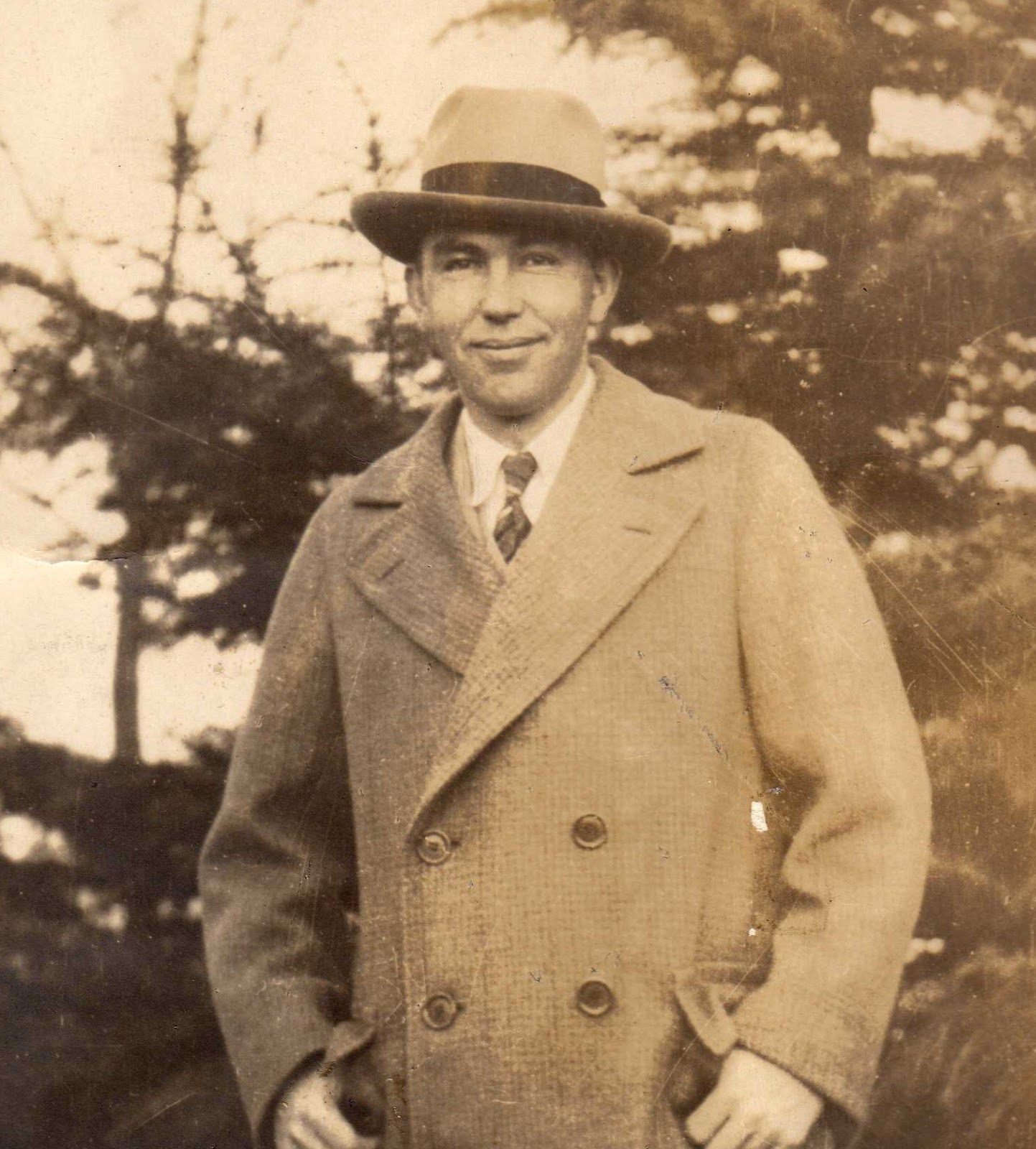
William Wallace "W.W." Colby and granddaughter   
Betty Werst in front of the house circa 1935

The third death in the house was that of my grandmother Ada Grace Colby Werst Branchflower. Moving there as a child of 9, she had spent most of her life in the home. She was asleep upstairs when her mother died. She had seen two of her sisters married in the living room. It had been a sanctuary when she was able to reunite her two daughters and move in with her Dad. I'm sure she did all that she could to ease his suffering before he died. She struggled to buy her sisters out of their portion of Pine Lawn Farm so she could keep her home. She raised her daughters there and they welcomed her new husband Kenneth Branchflower into the home. It became a favorite retreat for grandchildren visiting from California.
Grace Colby Werst in front of the house
with daughter Betty circa 1938.


She knew that her mother, grandmother Sarah Amanda Hugunin, her Aunt Grace Hugunin Bissell, sister Madge Colby Massey and Ethel May Colby King had all died as fairly young women, many in the forties. It wasn't until she was diagnosed with polycystic kidney disease that the family realized that the others had probably died of the same hereditary condition. Grace controlled the disease with careful salt-free dieting for years and tried to qualify for dialysis. Alas, the doctors were not going to approve using that expensive treatment on a woman who was 70. She died of a heart attack January 8, 1973.

The last death to occur in the house, was that of my step-grandfather Kenneth M. Branchflower. With the exception of his time overseas during the Second World War, he had made the house at Pine Lawn Farm his home after he and Grace married May 23, 1944. He had grown up on a farm up the street. After Hoo Hoo died, he talked about rehabilitating his family home which had been vacant since his father's death in 1958. He built a 3 bay garage and shop on that property as the first step in that transition. Unfortunately, he never had the opportunity to finish the job. He died in his sleep, presumably of a heart attack February 15, 1976.
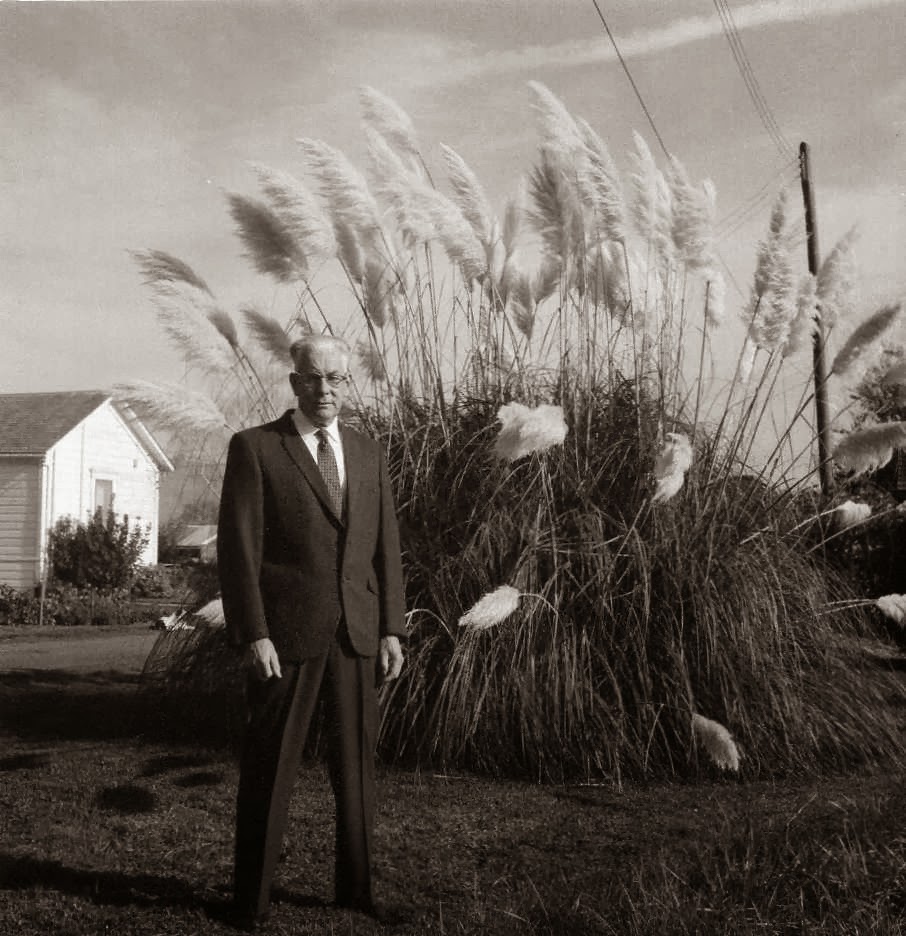
Kenneth Massey Branchflower at Pinelawn Farm 1975


Aunt Helen, my husband Ed and I drove from California to Newberg with heavy hearts arriving late at night. For some reason the power was off and the old house really did seem haunted. We ended up spending the night at good neighbor Alice Nelson's home across the street. It was the only time that I had been concerned about staying in the house.

Today, my aunt, siblings and cousins and I remember the many good times we had in the house. Though it has been rented to others for many years, the house remains in the family. Each time I visit Oregon, I make it a point to visit.

I am certain that you all know of many more stories of houses where family members lived, loved and died. Please feel free to share them with me.
Love,
Cecily

Saturday, September 28, 2013

1640 Puritan Psalter to be auctioned by Sotheby's

Dear Great Grandfather Thomas Thacher,
One does not expect, when living in 21st century Montgomery County Texas, to read an article in the morning paper referring to an item that might well have been used by a 9th great grandfather who died 326 years ago. That's what happened to me yesterday. The third page of the Conroe Courier led with an article from the Associated Press entitled, "1640 Puritan psalter goes on display in Houston."
The article went on to describe "The Bay Psalm Book", which will be displayed Thursday at the Museum of Fine Arts in Houston, as one of two owned by Boston's Old South Church.

A Psalter is sort of a hymnal. The psalms in the Bible were written to be sung. A psalter divided the poems by meter so they could be set to music, Beginning in 1620, the Pilgrims and Puritans had been using Psalters that they had brought to Massachusetts from England and Holland. The "Bay Psalm Book" was the first psalter printed in Massachusetts Bay Colony by Stephen Day in 1640. Members of the church leadership had been dissatisfied with the translations of the Psalms from their original Hebrew in their original Psalters so created a panel of their Ministers to undertake a new translation. Their creation is said to have been used for more than a century. Wikipedia provides a transcription of the title page of the 1640 first edition;

                                                          The Whole Book of Psalmes
                                                               396104         Faithfully
                                                             Translated into English
                                                                           Metre
                                                          Whereunto is prefixed a discourse
                                                      declaring not only the lawfullnes, but also
                                                       the necessity of the heavenly Ordinance
                                                             of singing Scripture Psalmes in
                                                                     the Churches of God
                                         
                                                                Cambridge, Mass. Stephen Day
                                                                     Imprinted, 1640

I know you were the first pastor of what we call the "Old South Church" in Boston taking the pulpit there 16 February 1670. You would have called it the Third Church. As these Psalters were used for a hundred years, I imagine that you had your hands on this copy as well as many others.

Today, there are only 10 known copies of the 1640 Psalter left. Two of the copies are owned by the congregation descendant from yours. The Old South Church has a congregation of more than 350 and meets in a 138 year old building that is showing its age. They have made the decision to part with one of their two copies of the Psalter. It's auction by Sotheby's (our premier auction house) is expected to net the church nearly 30 million dollars. The church is planning on using the funds generated by the sale to establish an endowment to maintain their building.

Somehow, I am certain that you would approve of their decision to sell though be somewhat stunned by the price this old hymnal is expected to bring.

Love,
Cecily


Sunday, September 8, 2013

Happy Grandparents' Day

Dear Grandparents,
In the last ten years or so, we have been celebrating Grandparents Day. My Grandson Cooper appeared at our door this morning with a card, saying "open it Grancy, its Grandparents Day."
It made me think about how lucky I am to be near my grandchildren and part of their lives. I was also lucky enough to know three out of my four grandparents and a step-grandfather who we always thought of as ours.

So today I'm introducing my grandparents....

First my maternal Grandfather and namesake Cecil Oscar Werst. Born March 16, 1900 in Valley Falls, Jefferson County, Kansas, Cecil was the 10th of 11 children born to Lewis Werst. His mother was Lewis' second wife Mary Jane Barnes.  His first wife Lunetta "Mattie" Fitzsimmons died shortly after her third son was born and her older boys were 4 and 2. Mary Jane really raised all of them. There was only one girl in the family.

Cecil was still an infant when his family moved to Garfield County, Washington following in the footsteps of his former brothers-in-law. The family soon moved on to the Belma area of Yakima County which has now been absorbed by Grandview. Lewis worked as a carpenter and construction manager. His death in 1916, forced Cecil to leave school to support his mother and younger brother.
In fact in the 1920 Federal census he is listed as the head of household, working as a laborer doing general work.

Cecil holding my mother Betty Lorraine Werst 
Spokane,
Washington 1926

In 1923 he was visiting his older brother Clem in Pendleton, Oregon. Across the street, my Grandmother Grace Colby was visiting her sister....they were married in Spokane, August 8, 1924.
Cecil was working as a manager at the Real Silk Hosiery Factory and Grace worked for the Spokane newspaper until the birth of their daughter Betty Lorraine Werst.

Unfortunately, the small family was shattered by Cecil's sudden death October 24, 1927. He had an abscessed tooth removed by a dentist and in the days before penicillin was dead within a week when and infection set in.

I never knew Cecil and my grandmother did not talk about him much as she had long since remarried when I was a child. Cecil also missed out on knowing his younger daughter Helen Louise who was born five months after he died. I wonder what he would think of the family he founded today.


Ada Grace Colby Werst Branchflower is my maternal Grandmother. Named for her mother's best friend Ada McNay and her sister Grace Hugunin, she was born October 21, 1902 on the Colby farm near Kirwin, Phillips County Kansas.  She was the last of five daughters born to William Wallace and Mary Elizabeth "Mamie" (Hugunin) Colby. She was more than ten years younger than her next sibling. She was the pet of the family and called 'tickie' because she was always running like a clock.

In 1912, the family left the familiar environs of Kansas moving to a Pine Lawn Farm just outside Newberg, Yamhill County, Oregon. They made the trip by train with Mamie and daughters Madge, Pansy and Grace riding in coach and W. W. Colby riding in the livestock cars with his prized mules.
Mamie died suddenly in 1917 at age 49 leaving Grace and W.W. stunned. They survived as Grace quickly stepped up to the role of lady of the house.

Graduating from high school in 1921, Grace left for Corvallis and Oregon Agricultural College (now Oregon State University). W. W. decided that he could not manage the home and farm without a woman's touch and married his late wife's best friend Ada McNay who had also been widowed. Returning from college in the summer of 1923, Grace found that her role as 'lady of the house' had been assumed by her father's new wife and there was not room for her. She promptly left for her sister Madge's in Pendleton. You know what happened from Cecil's story above.


I always admired my grandmother, widowed at age 25, she survived and cared for her children even returning to Newberg to care for her father when Ada McNay Colby died. She is responsible for my interest in family history and genealogy because I loved the stories she told of her family and ancestors. She died in 1973


My paternal grandfather, Charles Newton Cone was born December 6, 1898 in Worthington, Nobles County, Minnesota. The fourth of five children born to Frederick Naaman and Helen Brown (Newton) Cone. His family was also on the move shortly after his birth when the entire Cone, Clark, Newton clan moved to Mapleton, Utah. The family were lay missionaries for the Presbyterian Church. A precocious mind, young Charles chafed at the restrictions placed upon him being one of the few non-Mormons in school. The Springville Presbyterian church congregation took up a collection to send him to Fairmont College (now Wichita State University). He graduated in 1920 with a BS in Chemistry and followed his family to Salem, Marion County, Oregon.

Chemistry turned out to be not only his vocation but his avocation and he worked in the field until he was 88. His work in the plywood industry lead him indirectly to my paternal grandmother.

On a business trip to Memphis, Tennessee, he called on a local plywood manufacturer intending to sell him the new glue that he had developed. Chester Bynum Allen was very impressed by Charles' vision, personality and by the fact that he was still single.
Inviting him home to dinner, he introduced him to his unmarried daughter Hazel. In less than two weeks they were married and en route to their new home in Seattle.

Granddaddy lived until 1988 and I was lucky enough to spend lots of time with him.

My paternal grandmother Hazel Bynum Allen was teaching school in Memphis when the gallant young Charles Cone swept her off her feet. Hazel was second for four children born to Chester Bynum and Ida Mae (DYE) Allen. She was petite and redheaded like her father.

When she was about ten, her mother was injured in a railroad accident. Her injuries were so severe that she did not walk for many years. This left Hazel with a lot of responsibility for her younger sisters. My grandfather told me that her mother had expected that Hazel would not marry and instead remain at home to care for her parents in their old age. Evidently, she had not okayed this plan with her husband.

Grandmother was less than 5 feet tall and my Grandfather at 6' 2" towered over her. But do not think that he ruled the roost. It was clear to everyone that she could stand up for herself.

My step-grandfather Kenneth M. Branchflower married by maternal Grandmother Grace in 1944. He was the grandfather we knew on that side of the family. Poppy taught us to drive tractors, trucks, about pioneering, camping, burning trash, fishing for crawdads and so much more.

There is, of course, much more to each of their stories. I miss all of them today and honor their memory and their contributions to my character.

Love,
Cecily


Saturday, August 31, 2013

Surname Saturday THACHER

Dear Great Grandfather Thacher,
Those searching for information on the their ancestors often are hoping to find connections to European royal houses including castles and coats-of-arms. I have mostly been more interested in the stories of the individuals that make up the family. Sometimes, however, the two processes converge.
This is the case with you, my 9th great grandfather Thomas Thacher.

Born May 1, 1620 in Milton Clevedon, Somersetshire, England, the eldest son of Peter Thacher and his wife Anne Allwood. You were baptized in 1622 at the parish church in Sarum, Salisbury, England. Your father was the rector at the Church of St. Edmund in Salisbury from 1622 until his death in 1640/41. You and your family were Puritans. I imagine having lived through decades of religious unrest and persecution helped your father make the decision to send you to New England.

It is believed that you came to New England with your Uncle Anthony Thacher and his family. The New England Historic Genealogical Society's project "The Great Migration: Immigrants to New England, 1634-1635, Volume VII, T-Y" page 19 states that you sailed for New England on the James
in 1635. This inference comes from Cotton Mather's biography of you which states, "(a) day or two before that fatal voyage from Newberry to Marblehead, our young Thacher had such a strong and sad impression upon his mind about the issue of the voyage, that he with another would needs go the journey by land, and so he escaped perishing with some of his pious and precious friends by sea."
Many imagine that this story was created by Mather but one can imagine that a fifteen year old boy, so soon from such a long and arduous voyage across the Atlantic, would have been reluctant to set foot again on a ship. How terrible it must have been for you to know that so many of your cousins, friends and acquaintances died on that short trip.

Your surname Thacher is certainly of English origin. Most believe it is one of those surnames given to denote an occupation. Thacher or Thatcher was given to the man who roofed buildings with thatch.
Once when visiting my sister in Holland, we were driving through the countryside and happened upon someone replacing the thatching on a cottage. It was fascinating to watch. Of course, your family had long since left the thatching, seeming to prefer ministering to the faithful. Records indicate that you were "ordained at Weymouth, Massachusetts in 1644 where you were pastor for more than twenty years, and of the Old South Church, Boston eight years." (Genealogical and Family Historry of Northern New York" New York, Lewis Historical Publishing Company, 1910; transcribed by Coralynn Brown available at rootsweb.)  Your father, Rev. Peter Thacher, was a minister for more than 50 years. His father, also Rev. Peter Thacher served the church at Queen Camel from 1574 until 1624. Your son, another Rev. Peter Thacher was pastor at Milton, Massachusetts for forty-seven years.

This is a present day illustration of the seal that you used on a letter written in Boston, August 16, 1676 and addressed to your son Peter who was living in London at the time.


Thomas Thac(t)her Coat of Arms from the American Heraldry Society used with permission.
The American Heraldry Society provides the following description of the seal as a "Gules a cross Moline Argent, on a chief Or three grasshoppers Proper." They have found the seal on a letter written in 1676, the seal on another document, the seal on Thomas Thacher's will, and it was also used by his Uncle Antony Thacher.

The letter, with its impression of the seal, was handed down through the family of your son Peter. It was found in the papers of a 6th generation descendant Deacon Peter Thacher of Attleboro, Massachusetts. It is transcribed below


Boston, 16. 8, 1676
My Dear Son Peter:--I have received four letters from you, whereby I have joyfully, and I hope thankfully, taken notice of the kindness of God in your comfortable voyage to, and kind reception in England, by our friends; which  has enlarged my desires to hear further from you.
I hope also you have long ere this received mine to you. At present, you  may understand that God hath utterly scattered, delivered up, and subdued the heathen that first rose up against us, delivered up Philip to death, cleared the wasts of Plymouth, Narragansett, Connecticut, Quaboag &c, from those bloody and blasphemous heathen; but behold a new enemy is broken out to the east and northward, who have laid waste the country, &c; slain my good friend  Capt. Lake, and many others; and, this very day past, woeful tidings is come of the taking in by surrender Mr. Scott's+ garrison at Stony Point, he being but the last week come from the same to Boston, and leaving Esq. Joslin, as  they call him, chief commander. What the particular circumstances are, is not yet certain amongst us; but this is certain, that the place is taken; the garrison strong; two great pieces there; and many small arms, and good store
of provisions. Such a spirit of fear and cowardice is poured out on the inhabitants of those parts, that it is exceeding ominous. The Indians carry all before them, by sea and land, on the main and on the islands in Casco, having taken several vessels, one with two great guns in it, &c. This part of the war is like to be the more difficult, because so far off from us; because so near the French, who are reported to be among the Indians. This day it was
said that there were twenty in the exploit; but we have no certainty of it, and foolish jealousies my feign that fear makes scarecrows to affright the fearful, and a sluggard may say a lion is in the way. So, many of those fearful persons may think to hide their shame by such suggestions. As for  myself, I at present enjoy a comfortable measure of health and strength, though laboring under some weakness gotten in my sickness. If you have not more than ordinary encouragement, and a most evident call to stay in England,
I hope I shall see you here, if the Lord lengthens our lives to the next summer. The Lord guide your whole way, and bless you with all the blessings of his everlasting covenant, and make you a blessing wherever you come, that he may be your portion.
I had almost forgot to tell you that I received a letter from my brother, Paul Thacher, who lives in Salisbury, certifying that my brother John died  three years ago, very poor. That my mother-in-law's sister, one Mrs. Elizabeth Coombs, widow to Mr. Coombs, the great Ana-Baptist, is alive; she was a lively, hearty Christian, when I lived at Salisbury, and I am confident would rejoice greatly to see you; being an old friend of my father's. If you go thither, I presume that you will find many old friends that will rejoice
much to see you. But I fear such * * * *ne coming on in England, that I wish you here. To the * * * Dear Jesus I * * * on resting * * * Your dear father,
Thomas Thacher


I found the transcription of your letter in the rootsweb archives http://archiver.rootsweb.ancestry.com/th/read/GenMassachusetts/2001-06/0992976107. The link to the contact is unfortunately broken. The asterisks indicate areas that are unreadable. It would be wonderful to also find an image of the letter and seal but my searches have not been successful.

Reading the letter, really gives us an idea of the things that were of concern to you more than three hundred years ago.

Love, your 9th great grand daughter,
Cecily

P.S. For family members, here is our descent from Thomas. Thomas and wife Elizabeth Partridge had son, Rev. Peter Thacher who married Theodora Oxenbridge. Their son, Peter Thacher married Mary Prence and their son was Samuel Prence Thacher. Samuel married Sarah Cook Kent and their son was Nathaniel Thacher. Nathaniel married Lydia Place and their daughter Sarah married George Hornell, Jr. George's and Sarah's daughter Lydia Hornell married John Champion Clarke.  John and Lydia's daughter Mary Elizabeth Clarke married Charles Shepard Newton. Their daughter, Helen Brown Newton married Frederick Naaman Cone, my great grandfather.


Saturday, August 17, 2013

Surname Saturday - VAN VREDENBURG

Dear Grandparents,
It's been awhile since I've written a post for Surname Saturday. Today I've selected Van Vredenburg, one of the many surnames of Dutch origin found in our family tree. My 8th great grandfather, Willem Isaacsen Van Vredenburgh arrived in New Netherlands 17 May 1658 on the ship 'de Vergulde Bever' or gilded beaver. The patronymic Isaacesen in Willem's name indicates that he was the son of Isaac Van Vredenburgh.

Vredenburgh family researchers have put together a website that provides additional information about Willem's origin http://vredenburgh.org/vredenburgh/pages/dutch.htm. Kenneth Scott, writing an article "The Vredenburg Family" in the New York Genealogical and Biographical Record, volume 95, no. 2, P. 79 discusses records found in the "Geementearchief in Hague" stating on "July 16, 1634 banns were published in the Groote Kerk in the Hague for Ysack Wilernss Van Vredenburch, young man, and Cornelia Jans, young woman, both living in the Hague and they were married in the Groote Kerk on August 6, 1634, by Comine Eleasear Lotius." Mr. Scott cites his source as City Trouw Boek 742, p. 84, verso and Groote Kerk Boek 32, p. 73.


Most of what I know about Willem Isaacsen Van Vredenburgh comes from an article written by his descendant La Rue Vredenburgh of Sommerville, New Jersey and published in the Somerset County Historical Quarterly January 1918. It seems that Willem was a soldier in the service of the Dutch West India Company when he arrived in New Amsterdam (later New York City). It is unclear how long he remained in the service. La Rue states, "He is found later at Fort William Henrick in the City of New Orange (on Manhattan Island), Kingston and finally in New York City."

There is evidence that the Dutch practiced the 'law of eminent domain' as in "New Orange his is mentioned as having a house and lot in 1673, which was ordered to be pulled down because (it was) too near the 'walls and bulwarks' of the fort."

Willem married Appollonia Barents, the daughter of Jacob Barentsen and Marritie Leenderts of Amsterdam, Holland, October 19, 1664.

Our Van Vredenburg connections are on our Hugunin line. So for family members her is the descent,
Betty Werst; daughter of Grace Colby,; daughter of Mamie Elizabeth Hugunin; daughter of Van Eps Hugunin; son of Richard 'Dirick' Hugunin; son of David Huguenin and Baata Huyck; daughter of Dirk Huyck and Sarah Van Deusen; daughter of Isaac Van Deusen and Bata Van Ysselesteyn; daughter of Cornelisse Van Esselsteyne and Cornelia Van Vredenburg; daughter of Willem Issacsen and his wife Appolonia Barents Van Vredenburg.

So many more records to find on my next trip to visit my sister Trude in Amsterdam!
Love,
Cecily

Thursday, August 8, 2013

Employment Applications can be a great resource.

Dear Grandparents,
When researching your lives, we would all like to find a complete timeline that explains where you were living and what you were doing each year of your lives. Realistically, we know that we're not going to find that timeline. However, my sister Leslie has found one of the next best things for our Grandmother Grace Colby Werst Branchflower.

On May 13, 1947, (Mrs.) Grace C. Branchflower filled out an application for Federal Employment. All of us who have filled out similar forms, understand that it involves accounting for one's complete employment history, education as well as answering a variety of questions. Scope of jobs, salary, and supervisors are identified, as well as physical characteristics. For example, on the form Grace lists her height as 5' 5" and weight as 113 pounds. This fact was interesting to me as I always thought of her as being taller than my mother who was also 5'5".

1st of 7 pages of Grace's Federal Employment Application


The form answers several questions for the family. How long did she attend Oregon Agricultural College? During the time she was filling out the application, OAC had become Oregon State College. On the form,  she states she attended Oregon State College, Corvallis, Ore. There she majored in HE, presumably Home Economics. There is a mistake in the dates listed. She states she began in 9, 1922 thru 6, 1922. The best guess is that this should read through 6, 1923.

She also writes that she attended Northwestern Business College for 3 months taking a course in something called then Stenotypy. The location and dates of this course are not included. Following that she lists Dickinson's Shorthand School, Seattle, Washington where she took a 3 month class in Shorthand and Business training. There are no dates for that course either. We know that she was employed in Seattle from February 1929 to October 1930.

The years between her leaving Oregon State until she returned, with daughters in tow, to her father's home in Newberg have held the most questions for us. She told us that rather than returning to her home in Newberg, where her new step-mother was ruling the roost, she had gone to her sister's Madge's home in Pendleton. I was under the impression that few unmarried young women of good families worked outside the home in the 1920s so I had not looked for a work record for her before marriage. Page 7 of the application lists her previous employment and there she states that from
"February 1923 to May 1925" she worked for the "Real Silk Hosiery Mills" in "Pendleton, Oregon, Walla Walla, and Spokane, Washington." Her job responsibilities included, "Complete office management, instructing of sales force, general office, account, records and reports." She earned a salary of $175 per month. Someone named "L. A. Baker" was her supervisor and she left to be 'Married."


My impression, from the stories told by my mother and aunt, is that Grace helped Cecil obtain his first job with her company. His brother Clem and wife lived across the street from Grace's sister Madge and dentist husband Hal Massey. Cecil was working as a carpenter for his brother's construction company. I think they both had their sights set on bigger things.

That she left in May of 1925 when she married is interesting because she and Cecil Oscar Werst were married 8 Aug 1924 in Spokane. (As I am typing this, I just realized that today is the 89th anniversary of their marriage. Happy Anniversary Hoo Hoo and Cecil. We hope you are celebrating together today.)

Perhaps, Royal Silk had a policy preventing married couples from working for the company. Maybe, she offered to stay on after their marriage until she could train a replacement.

There is more to be discovered on this page later.

Once again, Happy Anniversary!
Love,
Cecily


Friday, August 2, 2013

Surname Saturday - Potter

Dear Grandparents,
When my friend Donna Potter Phillips suggested friends look for Potters in their family trees mention in her Potter Profiles blog, I decided I should conduct a search. I was fairly certain, that there wasn't a Potter in my direct line but since I've included my in-laws and a few out-laws in my tree, I'm afraid I can not remember every surname and exactly where it fits in. 

I did indeed find some Potters in my tree. They belong in my son-in-law Chris' paternal line. Donna published this information on her Potters' Profiles Blog but I add it here also in an effort to reach additional people.

My son-in-law's 6th great grandfather was Stephen Potter, born about 1744 in England or perhaps Wales. He married, about 1768 in Virginia, Jemima Green. They had at least 8 children among them, Thomas Green Potter. Some researchers report that Stephen served in the South Carolina militia from 24 May 1781 to 14 Jan 1782. Others that he was a mounted soldier in General Pickens' Brigade. He is not listed among in the DAR ancestor database. I have not been able to document this assertion.
 
Their son Thomas Green Potter was born either in Virginia or in Clinton, Laurens County, South Carolina about 1775 (date calculated from tombstone). He married Elizabeth Holland, daughter of  and William Holland and Ann Wayman, 1 Dec 1814 in Clinton, Laurens County, South Carolina. Elizabeth died in 1844. There is an obituary for Thomas at www.findagrave.com which lists him as a native of Virginia. It also states that he lived in Spartanburg and Laurens. Deacon Potter "for a period of forty years he was an exemplary member of the Methodist Episcopal Church."
 
Thomas and Elizabeth had the following children:
     Wayman Henry Potter 1816-1890
     Nancy Holland Potter 1819-1886
     Thomas Coke Potter  1821-1902
     Allen T. Potter 1824-1892
     Francis Asbury Potter 1826- 1900
     George Whitefield Potter 1828 - 1901
     Elizabeth Holland Potter 1830 - 1889
 
The 1820 Census for Spartanburg, Spartanburg, South Carolina, enumerated 7 Aug 1820, lists a Thos G Potter with a household including: 2 free white males under 10; 1 free white male 26-44; 1 free white female under 10; 1 free white female 16-25; on male slave 14-25.
 
The 1830 Census for Spartanburg enumerates a Thos G Potter household including: 2 free white males under 5; 2 white males 5-9; 3 free white males 10-14; 1 free white male 40-49; 1 free white female 10-14; 1 free white female 30-39 and 1 male slave 24-35.
 
The 1840 Census for Laurens, South Carolina lists a Thomas Potter in a household with 1 free white male 50-59; 1 free white male 20-20; 2 free white males 15-19; 2 free males 10-14; 1 free white female 10-14; 1 free white female 15-19; 1 free white female 20-29; 1 free white female 50-59; and 1 male slave 36-54.
 
The 1850 Census for Laurens, South Carolina lists a Thomas Potter, age 60, male, farmer, value of real estate 3100, birthplace Virginia. Also living in the household as  Frances A Potter, age 24, Birthplace South Carolina, male; George W. Potter, age 22, male; Elizabeth Potter, age 20 female.
 
My son-in-law's line descends from Wayman Henry Potter, born 17 Oct 1816 in Cross Anchor, Spartanburg, South Carolina. He married Elizabeth Jane Simpson about 1840 in Clinton, Laurens County, South Carolina.
The family had at least five children all born in South Carolina
     Mary J. Potter 1843
     Nancy Potter   1845
     Thomas Asbury Potter 1846-1919
     Sarah Potter 1849
     Amanda B. Potter 1854-1935
 
The family emigrated to Ouachita County, Arkansas about 1858.
 
Amanda Bailey Potter, my son-in-law's 3rd great grandmother, was born 12 Feb 1854 in South Carolina. She married Robert Weir Copeland (1852-1921) in 1874. The family made their home in Jackson, Nevada County, Arkansas and she lived in the county the rest of her life. The Copelands had six children:
     S. E. Copeland 1876
     Fannie Bailey Copeland 1879-1921
     Edgar W Copeland 1881
     Joe Bell Copeland 1884
     Amry R Copeland 1889
     Lizzie Faye Copeland 1893-1978
 
My son-in-law descends form Fannie Bailey Copeland so I do not have any additional information on Potters. Perhaps, someone will have information on Stephen Potter's Revolutionary War service in the South Carolina militia. 
 
The Potter surname is one of many whose origin can be found in the occupation of those originally named such. In this case, the national origin is undoubtedly from the British Isles but it might well be English, Irish, Welsh or Scots.
 
You, of course, know the answers. Wish you could share them with us....
 
Love,
Cecily